A Brief History


Back in 1978, I was attending college at Southwestern College in Winfield, Ks. The first fall I was there, I saw an ad for help at a local Bluegrass Festival. A college student, broke, chance to make extra cash? I was all over this, so I signed on. Not only did I get paid, but I received free tickets to the festival. So there I was, walking around on Saturday, when on one of the back stages was a mountain dulcimer workshop given by three attractive women. I still remember two of them, Cathy Barton and Mary Faith Rhodes. I sat back and watched. I also fell in love with the dulcimer. Here was a simple instrument that originated in the USA, the Appalachians in fact, and made with woods that I was very familiar with due to my families mid western logging business. I went to these ladies shows, watched the Dulcimer Championships. I spent my earnings on a very cheap dulcimer. I could not learn to play.

The strings were too high, it was poorly made. The next June, there was a June Jamboree segment of the fall festival. Once again, I worked it, this time I spent my earnings on a dulcimer kit. I built this with less than half the recommended tool list, I remember using a rock to pound in the frets and a stack of bricks for clamps. I ended up with an instrument that was more playable, and amazingly enough, better looking.

It was at this time I transferred to Iowa State. A few years into school there, I discovered that there was a wood shop available for student use. Wood from the family sawmill, and my first dulcimer was made. Again I looked at it, thought about it, saw my mistakes, a cherry board from Dad, and I built number two. It was an hourglass, all cherry, natural knotholes for the upper sound holes. My Mother still has this one, A-2. I made 5 dulcimers at Iowa State, except for #2, I have no idea where or who has them.

I ended up back at home next, worked for the family logging business, built a few more in the basement of my parents house. One of those was shipped back to Winfield, Ks. I also entered one in the county fair, it received a ribbon. Can't remember how many I built in Woodbine, but they were numbered W-6 on.

I ended up back in Winfield, Ks next. Here I decided to get serious about the dulcimer business. It was here that I also took first place in a major art show with one of my dulcimers. These dulcimers were numbered Wf-XX. Not sure the starting number, but when I moved I was in the 50's.

My next shop was in Wapello, Ia. Here I got busy. The last dulcimer built there was Wp-149. Formed a loose partnership with a singer/teacher named Pat Walke. She had me build a student model. These were very simple in shape and design, allowed me to use a lot of scrap lumber and also try out new and "exotic" woods such as mulberry and honey locust. It was here that I also branched out into other instruments. I built two 3/4 size guitars, 18 old-time banjos, 2 hammer dulcimers, some kalimbas, and assorted other things.

My next move was to Winfield, Iowa, where I built WFI-150 for my wife. That was over ten years ago, and I am ready to re-open my shop in Webster Groves, Mo.


Saturday, January 27, 2024

Monday, January 16, 2023

The amazing persimmon!

 Persimmon, the American ebony. Here is the Wood Data Base description of persimmon wood. Very wide sapwood is a white to pale yellowish-brown. Color tends to darken with age. Very thin heartwood (usually less than 1″ wide) is dark brown to black, similar to ebony. (Persimmon is in the same genus—Diospyros—as true ebonies.) More from the Wood Data Base. Common Name(s): Persimmon, White Ebony

Scientific Name: Diospyros virginiana

Distribution: Eastern United States

Tree Size: 60-80 ft (18-24 m) tall, 1-2 ft (.3-.6 m) trunk diameter

Average Dried Weight: 52 lbs/ft3 (835 kg/m3)

Specific Gravity (Basic, 12% MC): .74, .83

Janka Hardness: 2,300 lbf (10,230 N)

Modulus of Rupture: 17,700 lbf/in2 (122.1 MPa)

Elastic Modulus: 2,010,000 lbf/in2 (13.86 GPa)

Crushing Strength: 9,170 lbf/in2 (63.2 MPa)

Shrinkage: Radial: 7.9%, Tangential: 11.2%, Volumetric: 19.1%, T/R Ratio: 1.4


And finally a picture of a typical board.


Now to my story. A good friend, Steve Cunningham, gave me some short logs from a tree his neighbor cut down.


The tree was in Webster Grove, Missouri.


As you can see, not only were they bigger the normal, but the heartwood was much wider.

Sliced the logs in half, lengthwise with a chainsaw, then started the slow proscess of quartersawing with the chainsaw.


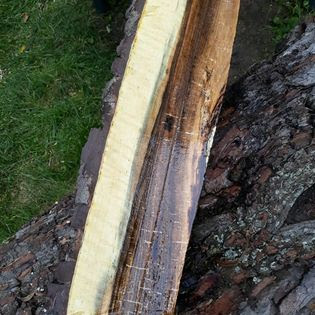

From here the boards were placed in my shop attic, carefully stickered together to dry. Fast forward 18 months or so and some of the boards were brought down for resawing. The dulcimer sized boards.


And of course, once you have thin stock, you start a build.


Will add more to this story as the build progresses. I still have quite a bit to resaw into ukulele stock.

And it is done.


Sunday, April 7, 2019

Next Dulcimers up

The sycamore didn't happen, but I returned to the spalted maple, it has a few more coats of finish to go. Next is a black locust with a Sequoia top. Yesterday I cut sides out of some curly burr oak, a truly beautiful wood. This dulcimer will be completely made of the curly burr oak. Then I need to build a few high chairs, and these will be followed by a couple bowed psalteries. And finishing a walnut guitar is a very priority. Keeping busy making sawdust!

Sunday, January 27, 2019

2019

I'm starting the year working with curly black walnut. Just finished a teardrop dulcimer all in curly walnut, next up is the new hourglass also in curly walnut throughout. I'm following that by finishing a sycamore dulcimer that I started a loooong time ago. It's the old style (middle design) of the hourglass, very slender. But I want to see how the wood sounds, so I decided to put a fretboard and scroll on it. Quarter sawn sycamore has a very unique grain pattern, but I fear that you will only see it close up. In a few weeks I will find out!

Tuesday, January 1, 2019

Dulcimer sounds

In the world of musical instruments, getting the "proper" sound is of utmost importance. There are reams of written instructions on how to tune in the violin or guitar. The dulcimer is a little different. We use a much wider variety of woods, different shapes, string lengths, etc, and as long as it sounds pleasant, it is good to go. This is one reason I think everyone should buy their dulcimer in person, hear the different sounds, pick one you like.
I put together a short video showing the differences between a very soft top, eastern red cedar, and a very hard top, curly white ash. Take a listen and let me know what you think.
https://www.youtube.com/watch?v=WMIg-Ba4dbA

Saturday, May 12, 2018

Guitar number 6

I started my next guitar, it is curly walnut with a red spruce top. I love the appearance of red spruce, but worry if it is being harvested responsibly. The seller said he bought a mountain top of red spruce trees and is cutting only the ones suitable for guitar tops, letting the others grow. Hopefully, this will be a continuing source of red spruce.
The next dulcimer up is almost finished, curly walnut with a curly ash top. needs a fretboard and scroll.
I have noticed that while I post pictures of finished instruments here, I do not post anything else. I'm hoping to keep this blog up to date from here on out!
Image may contain: indoor

Saturday, November 25, 2017

Bowed Psaltery

Finished the bowed psaltery, top is German Spruce (salvaged from a pallet), sides and pin block are curly sugar maple and the back is catalpa. Has a wonderful sound nd my wife, Pam has claimed it and is learning a few Christmas carols.
Today, I work on a hammer dulcimer.

Wednesday, November 1, 2017

Fall shop work

It's been over a month since I've been able to get into the shop, but I should finally have time. Up to today, I've been without heat, the shop heater was brought into the house because the house furnace was dead. That has been fixed today.
I have several projects that need to be finished, a white oak guitar, a sycamore dulcimer, a bowed psaltery and a hammer dulcimer. I have been asked to make a bowed dulcimer and another banjo. Life has become very busy.

Sunday, January 15, 2017

#160 almost done

Put the first coat of finish on #160. The dulcimer is all walnut, looks nice, all quarter sawn, no fancy figure, but still stands out. Walnut is a great wood!

Sunday, September 18, 2016

Guitar #5 is coming along nicely. Here's a few photos of yesterdays work.


The top is glued up. This is Sitka Spruce sourced thru Alaska Speciality Woods. They do not cut down trees, but rather obtain the wood from fallen trees, trees that were once used as floats, etc. A very green way to obtain some spectacular lumber!
This is the back. It is quarter sawn white oak, a hard dense wood that should ring out as well as the best rosewood. Logging oak in the USA is a sustainable enterprise. Where as most tropical hardwoods are the result of rain forest being cut down to make way for farms and cattle ranches. I use nothing but US and Canadian woods in my products.

Monday, September 5, 2016

Back in the shop.

It's been a while, many projects not finished, diving in and finishing. Coming up is a dulcimer with a yellow cedar top, black walnot everywhere else except the tuners and binding. The binding is curly bigleaf maple, the tuners will be white oak to tie in with the sound holes. Leaves have been intriguing me lately.
Speaking of white oak, guitar number 5 is made from white oak. I think I'll use a walnut neck and a persimmon fretboard. This will be followed by a walnut back and side guitar.
I'm glad I'm getting back in the shop, enjoying the smell of sawdust and the sound of a plane slicing thru wood.

Saturday, February 13, 2016

New Ebay Listing

Put #158 up for sale on Ebay. Ebay had a recommended starting price which I used, 42.50. Hope this doesn't bite me in the butt. See it at http://www.ebay.com/itm/-/151982824906?ssPageName=ADME:L:LCA:US:1123

Sunday, January 10, 2016

Old pictures

Found a picture from yesteryear. Had trouble keeping these in stock back then, the fretless ones sounded really good in the hands of a good claw hammer player.

Saturday, January 9, 2016

Mountain Banjo

This banjo is halfway finished. An interesting take on the old "Fox Fire" banjo.

Monday, December 21, 2015

Sawdust is flying

Back in the shop working on guitar #5, back and sides will be white oak, experimenting with the side profile a little, slimmed it down and removed the slimming at the top. Will see what it looks like when finished.
Also am working on a five string double rim banjo. All walnut.

Saturday, November 28, 2015

#156


Work Haulted

Not totally, am applying finish to two dulcimers and a guitar. No making sawdust for at least a week. But that's OK, the guitar will be ready by Christmas, my grand-niece should be happy, perhaps I will be able to sell the dulcimers at Christmas time. Looking forward to the next guitar on the build list, am needing to figure out a better  way to cut binding slots, and work on the heel. Sooner or later, I'll get the guitar build down. As long as I'm having fun!

Friday, October 30, 2015

Coming up


Two dulcimers and another guitar. Need to fret the curly maple dulcimer, sand all three out, then the finishing commences!